




The Role of On-Board Chargers in Electric Vehicles

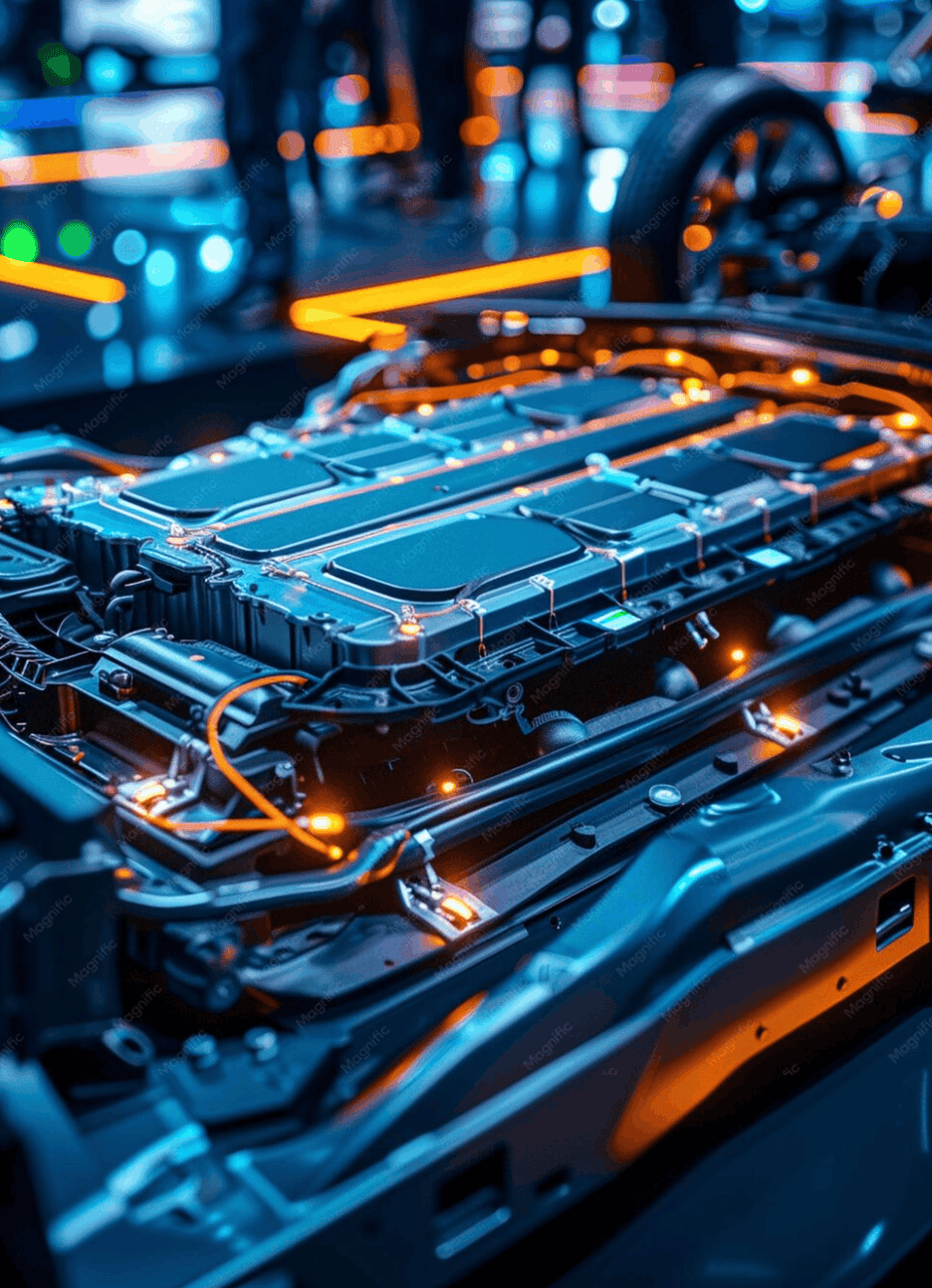
For most electric vehicle (EV) users, charging takes place at home, at work, or at public charging stations using alternating current (AC) electricity. The technology inside the vehicle that enables this process is the on-board charger (OBC). Since EV batteries store energy as direct current (DC), the OBC converts AC electricity from the grid into the DC power required by the battery while regulating the charging process to ensure safe and efficient operation. As one of the main power electronic subsystems in an EV, the OBC directly influences charging performance and energy efficiency [1], [3].

AC Charging and DC Fast Charging

Electric vehicle batteries operate using direct current (DC), typically based on 400 V or 800 V battery architectures, whereas homes, workplaces, and many public charging points supply alternating current (AC), usually at 230 V single-phase (or 400 V three-phase). Because the battery requires DC power at a different voltage level, electrical energy must be converted before it can be stored.

During AC charging, this conversion is performed inside the vehicle by the on-board charger (OBC), which converts grid AC into battery-compatible DC while regulating the charging process. During DC fast charging, the charger delivers DC directly to the battery, ‘bypassing’ the OBC. While DC charging enables high charging powers up to 350 kW, efficient on-board chargers remain essential because most everyday charging still relies on AC infrastructure [1], [3], [6].

Improving Charger Performance

Developing more efficient OBCs reduces energy losses, heat generation, and cooling requirements, improving overall vehicle efficiency. One of the key technologies enabling these improvements is the use of gallium nitride (GaN) bidirectional switches (BDSs). Compared with conventional unidirectional devices, BDSs reduce the number of components required in the power converter, leading to lower losses and higher power density, allowing chargers to become smaller, lighter, and more efficient [2], [4], [5].

ODYSSEV’s Modular On-Board Charger Innovation

Within the ODYSSEV project, a modular 22 kW on-board charger is being developed using parallelisable power modules based on the latest BDS technology. Instead of relying on a single converter, the charger distributes power across multiple modules, providing a flexible architecture that can be scaled according to vehicle requirements. This modular approach supports higher efficiency, compact integration, and improved thermal performance while simplifying future upgrades and system optimisation.

Supporting Next-Generation Electric Vehicles

The ODYSSEV on-board charger complements the project’s high-voltage battery architecture by providing a high-performance solution for everyday AC charging, while fast DC charging is supported through the battery’s design. Together, these technologies create a flexible charging ecosystem that combines efficient daily charging with compatibility for ultra-fast charging infrastructure, supporting the next generation of electric vehicles.


References
[1] S. S. G. Acharige, M. E. Haque, M. T. Arif, N. Hosseinzadeh, K. N. Hasan, and A. M. T. Oo, “Review of Electric Vehicle Charging Technologies, Standards, Architectures, and Converter Configurations,” 2023, IEEE Access, vol. 11, pp. 41218–41255.
Link: https://www.researchgate.net/publication/370036926_Review_of_Electric_Vehicle_Charging_Technologies_Standards_Architectures_and_Converter_Configurations
[2] A. Khaligh and M. D’Antonio, “Global Trends in High-Power On-Board Chargers for Electric Vehicles,” IEEE Transactions on Vehicular Technology, 2019, vol. 66, no. 6, pp. 4946–4957.
Link: https://www.researchgate.net/publication/330880553_Global_Trends_in_High-Power_On-Board_Chargers_for_Electric_Vehicles
[3] M. Yilmaz and P. T. Krein, “Review of Battery Charger Topologies, Charging Power Levels, and Infrastructure for Plug-In Electric and Hybrid Vehicles,” 2013, IEEE Transactions on Power Electronics, vol. 28, no. 5, pp. 2151–2169.
Link: https://www.researchgate.net/publication/260496532_Review_of_Battery_Charger_Topologies_Charging_Power_Levels_and_Infrastructure_for_Plug-In_Electric_and_Hybrid_Vehicles
[4] J. Millán, P. Godignon, X. Perpiñà, A. Pérez-Tomás, and J. Rebollo, “A Survey of Wide Bandgap Power Semiconductor Devices,” 2014, IEEE Transactions on Power Electronics, vol. 29, no. 5, pp. 2155–2163.
Link: https://www.researchgate.net/publication/260419009_A_Survey_of_Wide_Bandgap_Power_Semiconductor_Devices
[5] J. Biela, M. Schweizer, S. Waffler, and J. W. Kolar, “SiC versus Si—Evaluation of Potentials for Performance Improvement of Inverter and DC–DC Converter Systems by SiC Power Semiconductors”, 2011, IEEE Transactions on Industrial Electronics, vol. 58, no. 7, pp. 2872–2882.
Link: https://www.researchgate.net/publication/224171132_SiC_versus_Si-Evaluation_of_Potentials_for_Performance_Improvement_of_Inverter_and_DC-DC_Converter_Systems_by_SiC_Power_Semiconductors
[6] International Energy Agency (IEA), Global EV Outlook 2025, 2025.
https://www.iea.org/reports/global-ev-outlook-2025
[7] Fraunhofer Institute for Integrated Systems and Device Technology (Fraunhofer IISB), “On-Board Chargers and Active Front End (OBC and AFE).”
https://www.iisb.fraunhofer.de/en/research_areas/power_electronics/OBC_AFE.html

Log in with your credentials

Forgot your details?